

Teeth-Grinding Splints for Children and Adolescents in Frankfurt am Main
Many parents in Frankfurt am Main notice that their child grinds their teeth at night, makes grinding or clenching noises while sleeping, or complains of jaw, facial, or headaches in the morning. Studies estimate that about 15–30 % of children and adolescents grind their teeth from time to time, especially during periods of growth and stress. Parents then naturally wonder whether this is a harmless developmental phenomenon or whether treatment is advisable.
A nightguard for children and adolescents in Frankfurt—also known as a bite guard, mouthguard, dental splint, or bruxism guard—can help protect teeth, temporomandibular joints, and muscles in many cases. At Skyline Orthodontics Frankfurt in the Europaviertel, located directly on Europa-Allee near Skyline Plaza and the Frankfurt Trade Fair, we provide parents with carefully tailored advice. Our goal is to treat patients only when it makes medical sense. Our guiding principle is therefore: As much as necessary, as little as possible.
What is a bite guard for children and adolescents?
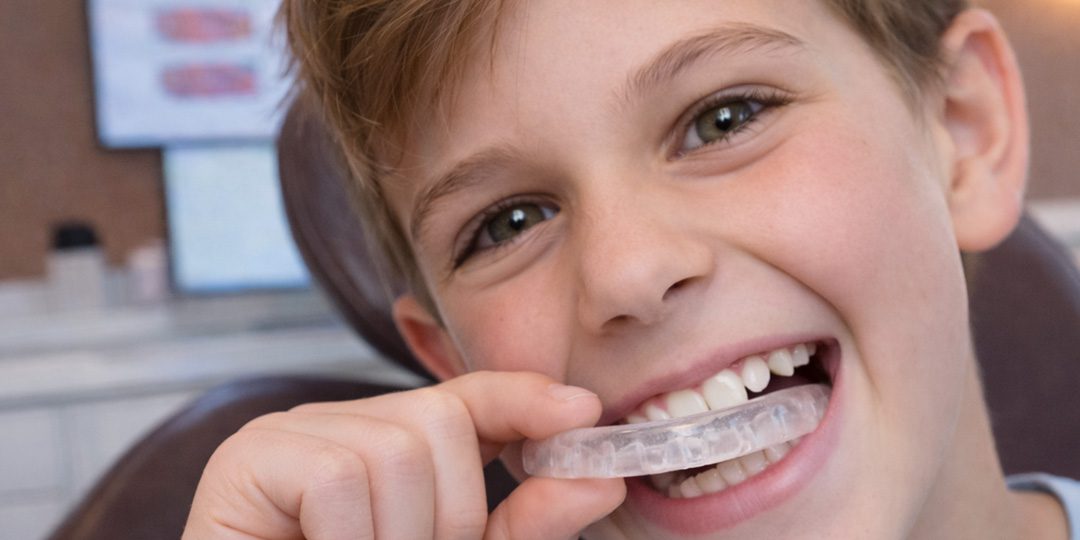
A night guard is a custom-made dental splint that is usually worn at night. It prevents the upper and lower jaws from coming into direct contact when grinding or clenching. This relieves pressure on the tooth structure, temporomandibular joints, and masticatory muscles. Terms such as bite splint, occlusal splint, dental splint, tooth splint, or bruxism splint essentially describe the same therapeutic concept.
However, the key factor is how such a splint is designed. At our orthodontic practice in Frankfurt am Main, near Skyline Plaza in the Europaviertel, we always take your child’s current stage of development into account. Children’s and adolescents’ jaws are still growing, and their bite is constantly changing. Therefore, a bite splint must not be used in a one-size-fits-all manner, but must be precisely tailored to tooth replacement, jaw development, and bite alignment.
Bruxism splint or grinding splint—which term is correct?
The terms “knirscherschiene” and “knirschschiene” are used very frequently in connection with teeth grinding (bruxism) in children and adolescents and often cause confusion among parents. In fact, both terms refer to the same orthodontic treatment. This refers to a custom-fitted plastic night guard that is typically worn at night and reliably protects your child’s teeth from the harmful effects of teeth grinding.
The difference between a “teeth-grinding splint” and a “bruxism splint” lies not in their function, but solely in their linguistic usage. “Teeth-grinding splint” is the more technically precise term, as it refers directly to teeth grinding. The term “knirschschiene” is often used colloquially as a shortened form. In practice—including among dentists and orthodontists—both terms are correct and commonly used.
Teeth Grinding and Clenching in Children and Adolescents – How Does a Mouthguard Help Prevent Teeth Grinding?
Teeth grinding in children and adolescents (medically known as bruxism) often manifests as nighttime grinding, clenching the teeth tightly together, or unconscious jaw movements during sleep. This behavior is particularly common during childhood and adolescence, especially during growth spurts, periods of school-related stress, or when there are changes in the bite.
A mouthguard for teeth grinding in children acts as a protective buffer between the upper and lower jaws. The mouthguard prevents your child’s teeth from coming into direct contact with each other, while also relieving pressure on the sensitive jaw joints and the still-developing chewing muscles.
This protection is especially important for children and adolescents: A bruxism guard or teeth-grinding splint used early on can prevent abnormal stress patterns from becoming permanently established in the jaw or tooth enamel from wearing down at a young age. Especially in cases of regular nighttime teeth grinding and grinding while asleep, a nightguard helps protect the teeth, temporomandibular joints, and surrounding muscles in the long term.
Are you looking for an orthodontist in Frankfurt for children and teens?
Teeth-Grinding Splints for Children & Teens – What Parents Should Know
A teeth-grinding guard for children or adolescents differs fundamentally from those for adults. While adults’ teeth are fully developed, children and adolescents are still growing. Parents therefore often ask us: “What should we do about teeth grinding in children?”
If you regularly grind your teeth at night, grind your teeth while sleeping, or clench your jaw tightly, a custom-made night guard may be a good option. It not only protects your teeth but can also help correct abnormal stress on the temporomandibular joint at an early stage.
Expert opinion by Dr. Dominik Krüger—specialist in orthodontics, state-certified physical therapist, and co-founder of Skyline Orthodontics Frankfurt:
“Teeth grinding in children is rarely just a dental problem. Muscle tension, the temporomandibular joints, and even posture often play a role. That’s why at Skyline Orthodontics, we always consider the entire functional system—teeth, jaws, muscles, and posture—and then decide together with the parents whether a nightguard is appropriate.”
– Dr. Dominik Krüger – Specialist in Orthodontics, State-Certified Physical Therapist
Are Night Guards Safe for Children? Disadvantages & Side Effects
Parents in Frankfurt am Main are understandably seeking information about the potential drawbacks of a night guard or the side effects of a bite splint. As a general rule, a night guard that is properly fitted and regularly checked is very safe.
During the first few nights, you may experience a slight feeling of pressure or go through a brief adjustment period. These reactions are usually temporary. It is important to have the splint checked regularly and adjusted as needed to prevent improper pressure distribution.
Dr. Dominik Krüger, a specialist in orthodontics and a state-certified physical therapist, explains:
“With children in particular, a cautious approach is crucial. A bite splint is meant to protect and relieve pressure—it must never control or hinder growth. That’s why we regularly check the fit and consistently adjust the splint to accommodate the child’s development.”
– Dr. Dominik Krüger, specialist in orthodontics and state-certified physical therapist
How does treatment with a bite guard work for children and adolescents?
It is especially important for children and adolescents that treatment with a bite splint be gentle, precise, and anxiety-free. At Skyline Orthodontics Frankfurt in the Europaviertel, we therefore consistently rely on a fully digital treatment process—without uncomfortable impressions or the gag reflex.
We always begin with a thorough consultation with the parents and an examination tailored to the child. During this process, we assess the teeth, bite, temporomandibular joints, and the interaction of the muscles. This is followed by a digital 3D scan of the teeth. This modern intraoral scanner completely replaces the traditional impression taken with impression material and is much more comfortable for children.
Based on this high-precision 3D scan, the bite guard for your child is designed directly in our in-house laboratory. The mouthguard is manufactured on-site at Skyline Orthodontics Frankfurt using state-of-the-art 3D printing technology. This offers significant advantages: The mouthguard fits exceptionally well, is individually tailored to your child’s developing teeth, and can be quickly adjusted or remade as needed.
After the aligner is fitted, we’ll take the time to explain to you and your child how to wear and care for it. Regular follow-up appointments ensure that the aligner adapts optimally to your child’s teeth as they go through the transition to permanent teeth and continue to grow. Thanks to our digital workflow and in-house fabrication, we achieve exceptionally high precision and quality—a key difference from standardized solutions.

Cleaning a Teeth-Grinding Guard – Care & Hygiene
Proper cleaning of the mouthguard is crucial for hygiene, comfort, and durability. A clean mouthguard is especially important for children and teenagers to prevent bacteria, odors, and damage to the material. With a simple routine, cleaning your mouthguard can be easily incorporated into your daily life.
After wearing it in the morning, the dental splint should first be rinsed thoroughly with lukewarm water. Afterward, we recommend cleaning all surfaces of the mouthguard with a soft to medium-bristled toothbrush. Mild soaps, gentle dish soap, or regular toothpaste are all suitable for daily cleaning.
It is important to avoid toothpastes with whitening effects or coarse abrasive particles. These can roughen the surface of the mouthguard, causing plaque to build up more quickly. You should also avoid hot water and harsh cleaning agents, as they can make the plastic brittle or warp the mouthguard.
For more thorough cleaning to remove tartar, biofilm, or stubborn deposits, special cleaning tabs for braces can be used once or twice a week. Alternatively, the mouthguard can occasionally be soaked in a mixture of water and vinegar or citric acid in a 1:1 ratio. Afterward, the mouthguard should always be rinsed thoroughly with clean water.
To prevent mold growth, it is important to let the mouthguard dry completely after cleaning and to store it in a clean place—ideally in a special braces case that allows for air circulation.
Pro tip from Skyline Orthodontics Frankfurt in the Europaviertel: Parents can incorporate cleaning into daily life in a playful way. This way, caring for the bite guard quickly becomes a regular routine, and your child learns early on to take responsibility for their dental health.
Are you looking for an orthodontist in Frankfurt for children and teens?
Teeth-Grinding Splints: Costs & Health Insurance—What Parents Should Know
One of the most common questions is: How much does a nightguard cost? or How much does a nightguard for children cost? The cost of a nightguard depends on the individual diagnosis, the complexity of the fitting, and insurance coverage.
In certain cases, a bite guard is covered by health insurance, or the health insurance provider may contribute toward the costs. At our practice in Frankfurt’s Europaviertel, we provide parents with clear information about which services are covered and when they may be required to pay a copayment.
Why a night guard for children is a good idea when visiting an orthodontist
Parents in Frankfurt am Main, in particular, often wonder whether their child’s bite guard should be made by a dentist. For children and adolescents, however, it often makes sense to have the treatment performed specifically by an orthodontist.
The key difference lies in the focus on growth and function. As specialists in orthodontics, we assess not only individual teeth but also the interplay between the bite, the temporomandibular joints, the muscles, and development. This holistic approach is particularly crucial when it comes to splints for the temporomandibular joints, as it helps prevent long-term malocclusions.
Your Specialists in Braces for Children in Frankfurt am Main
Skyline Orthodontics Frankfurt is centrally located at Europa-Allee 54 in the Europaviertel—right next to Skyline Plaza, near the Frankfurt Trade Fair grounds, and just a few minutes from Frankfurt Central Station.
Parents appreciate the practice’s specialization in pediatric and adolescent orthodontics, the daily presence of Dr. Dominik Krüger—a board-certified orthodontist and state-certified physical therapist—as well as the additional international expertise of PD Dr. Babak Sayahpour, an internationally recognized aligner expert and recipient of the Align Technology Research Award. Modern digital diagnostics and a seamless digital workflow ensure precision and safety.
If you would like expert advice on bite guards for children and adolescents in Frankfurt, we cordially invite you to schedule an appointment at our practice in the heart of the Europaviertel.
Are you looking for an orthodontist in Frankfurt for children and teens?
FAQ – Night Guards for Children and Teens in Frankfurt
How to get to our practice in Frankfurt's Gallusviertel
Here's how to reach us by all modes of transportation:
- Line M46 – Dubliner Straße stop (right outside the door)
- Frankfurt (Main) Trade Fair – S3, S4, S5, S6 (about a 5-minute walk)
- Lines 11, 14, 21 – Galluswarte or Güterplatz stops
- There is ample parking available at the Skyline Plaza parking garage (about a 5-minute walk away)
